
Start my smile experience
Please do not use this form to send health information.
Oops! Something went wrong while submitting the form.
Have a cracked tooth or a large filling that keeps breaking down? Dental onlays restore strength and function without removing more tooth than necessary.
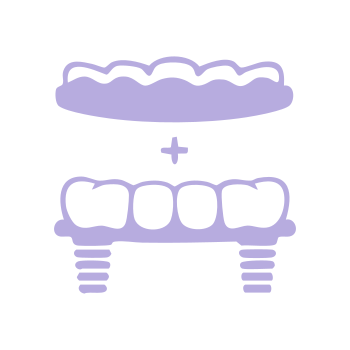
A dental onlay is a custom restoration that rebuilds only the damaged part of a tooth, usually the chewing surface or one or more cusps, instead of covering the whole tooth the way a crown does. It sits in the gap between a filling that is no longer predictable and a crown that is more than the tooth needs. At Opal Dental Studio in Huntersville, NC, Dr. Abbey Gonzales plans every onlay around your bite, so the restoration supports the tooth rather than fighting it.


Some teeth reach a point where a simple filling is no longer predictable, but a crown feels like too much. That gray area is often where onlays are considered.
Onlays are commonly recommended when:
An onlay focuses on strengthening the part of the tooth that actually needs support, while preserving as much healthy structure as possible.
Not sure where your tooth falls on that spectrum? We’ll examine the tooth, explain why each option matters, and help you choose a solution that fits your bite and long-term goals.
When a tooth is damaged, the real question is not what can be done, but how much needs to be done. Each of these solves a different level of the problem.
The decision is based on long-term predictability, not simply choosing the biggest or most aggressive solution. If you’ve been told you “need a crown,” ask us whether an onlay could be an option.
Before recommending an onlay, Dr. Gonzales looks closely at the condition of the tooth and how it functions within your bite.
We examine the tooth for fracture lines, wear patterns, and existing restorations. Digital images and clinical photos help us assess how much healthy structure remains and where stress is concentrated. Dr. Gonzales also evaluates how your teeth come together when you bite and chew, including signs of clenching or grinding.
The area is numbed for comfort, and only the portion of the tooth that needs reinforcement is shaped. We then capture precise measurements using a digital scan or impression, which allows the onlay to be designed to fit your tooth and bite accurately.
When the tooth needs coverage between visits, we place a temporary restoration to protect it. It shields the prepared area, maintains comfort, and helps keep the bite stable while the onlay is being made. We’ll show you how to care for it, including what foods to avoid and how to keep the area clean. If the temporary feels loose, rough, or changes how your teeth come together, let us know.
Once the onlay is ready, we carefully bond it into place and check its fit with your bite, making small refinements as needed so chewing feels natural and balanced. Before you leave, we confirm comfort, smooth the surface, and make sure the restoration blends seamlessly with the surrounding tooth.
Patients often ask one question first: will it look natural? The answer depends on the material and how it is selected for your tooth. We choose based on function, bite forces, and long-term durability, not a one-size-fits-all approach.
Tooth-colored restorations designed to blend in naturally. When planned and bonded properly, they offer excellent strength and resist staining over time.
In certain situations, composite materials may be appropriate. This depends on the size of the restoration, the location of the tooth, and how much force it takes when you chew.
Less common today, but still a reliable option in select high-force areas. These materials can perform very well when durability is the primary concern.
There is no single “best” material for everyone. We look at how the tooth functions, how you bite, and what you want long-term, then recommend the option that makes the most sense for you.
It’s normal to have questions about how an onlay will feel, both during and after treatment. Setting clear expectations helps most patients feel more at ease going in.
We numb the area before starting, so you should not feel pain during the procedure. Most patients describe pressure or vibration rather than discomfort.
Afterward, it’s common to notice mild soreness or temperature sensitivity, especially when biting or chewing. This usually settles as the tooth adjusts and the surrounding tissue calms down. If anything feels sharp, uneven, or lingers longer than expected, we want to know so we can check it.
If dental visits make you uneasy, tell us. We offer comfort options, including nitrous or mild sedation when appropriate, and we’ll talk through what would help you feel most comfortable. Whether that means taking breaks, explaining each step, or adjusting the pace, we adapt the visit to you.
There isn’t a single timeline that applies to everyone. How long an onlay lasts depends less on the number and more on how the tooth is used and cared for over time.
Several factors play a role:
In our Huntersville practice, we design onlays to work with your bite, not against it. When an onlay fits well and the forces on the tooth are managed, it can remain stable and functional for many years.
If you clench or grind your teeth, a night guard may be recommended to protect both the onlay and your natural teeth. Longevity comes down to planning, protection, and follow-up.
Right after placement, ease back into chewing on that side. Start with softer foods and pay attention to how the tooth feels as your bite adjusts. You don’t need to avoid normal eating long-term; just give the restoration time to feel natural.
Daily care stays straightforward. Brush and floss as you normally would, taking care around the edges of the onlay to keep the area clean and healthy.
If you tend to chew ice, bite pens, or crack hard foods, it’s a good idea to avoid those habits. Excessive force can stress any restoration over time.
We know cost questions come up early, especially when treatment goes beyond a simple filling. Our goal is to make the financial side clear and manageable before any work begins. Before anything starts, we review your options, answer questions, and make sure you understand what to expect financially.
An in-office membership for patients without traditional dental insurance. Includes preventive care and offers savings on restorative treatment.
See Our Wellness PlanWe focus on preserving healthy tooth structure whenever possible. That means choosing restorations that reinforce what’s already there instead of defaulting to full coverage when it isn’t needed.
Every restoration starts with a clear plan. We look at the condition of the tooth, how it functions in your bite, and what will hold up long-term before recommending next steps.
Restorative work should feel natural and look right. Our goal is to restore strength and comfort first, while making sure the result blends seamlessly with the surrounding teeth.
Patients appreciate visits that run smoothly and feel well-coordinated. We prioritize clear communication and preparation so your time in the chair is used thoughtfully.
As a local practice, we care for patients from Huntersville and the surrounding Lake Norman area. That long-term relationship matters when it comes to planning care that supports your health over time.
An onlay restores only the damaged portion of the tooth, usually the chewing surface or cusps. A crown covers the entire tooth. The choice depends on how much healthy structure remains and how the tooth functions in your bite.
In some cases, yes. When a filling would be too large or unpredictable, an onlay can provide added strength and stability. For smaller areas of damage, a filling may still be the better option.
Onlays typically require more than one visit. One visit focuses on evaluation and preparation, and another is used to place and adjust the final restoration.
The tooth is numbed during treatment, so you shouldn’t feel pain while it’s being done. Mild soreness or sensitivity afterward is common and usually improves as the tooth adjusts.
Yes. Many onlays are made from ceramic or porcelain materials designed to blend naturally with surrounding teeth.
An onlay can often restore and protect a tooth with a cracked chewing surface or weakened cusp. Deeper or more extensive cracks may require a different approach.
Clenching or grinding can place extra stress on any restoration. In those cases, we may recommend protective measures, such as a night guard, to help reduce wear.
Brush and floss normally, pay attention to how the bite feels, and avoid biting very hard objects. Let us know if sensitivity or discomfort doesn’t improve.
Coverage depends on your specific plan. We file insurance on your behalf and review expected benefits with you before treatment.
Dentistry evolves as teeth change over time. If a tooth needs additional treatment in the future, we’ll explain why and walk you through the next steps calmly and clearly.
If a tooth keeps breaking down, feels unstable, or you’ve been told you need a crown, you don’t have to guess what the right solution is. We’ll evaluate the tooth, explain your options clearly, and help you choose the most conservative approach that still holds up over time. Opal Dental Studio serves Huntersville and the Lake Norman area, including Cornelius, Davidson, and Mooresville.
Please do not use this form to send health information.